
An extra boost where it’s needed most
Over the past decade, the Sister Islands Association has expanded its efforts to support Ometepe young people who have special needs.
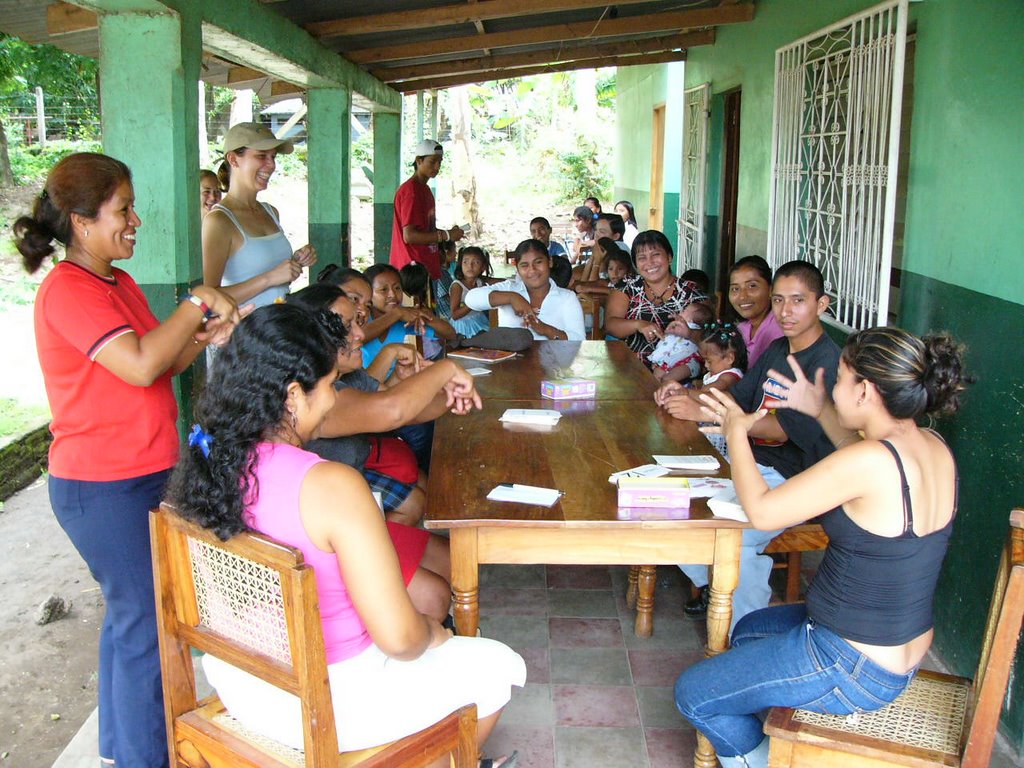
When the Sister Islands Association began sponsoring sign language workshops in 2008, some of the deaf students and their families got their first introduction to Nicaraguan Sign Language, a rich, distinct system for communicating.
Our efforts began during the 1990s, when we received a request from Ometepe for Braille typewriters and paper, which we were able to provide with help from a group of vision-impaired people on Bainbridge Island. In November 2005, Sister Islands Trustee Dale Spoor led the first of several delegations focusing on children with special needs. Beth Schoenberg, a teacher of American Sign Language interpreters, motivated the delegation to meet with a group of deaf students, their parents, and the special education teacher on Ometepe, Marcos Cordoncillo. At the families’ request, Sister Islands sponsored a month-long series of classes in Nicaraguan Sign Language (NSL) led by two teachers from the school for the deaf in Bluefields, Nicaragua. For the first time, some students and their families realized that they could learn to communicate using NSL.
In early 2009, Sister Islands commissioned a survey by Marcos (by then retired) and Karla Varela, a local psychologist, that identified more than 250 people with special needs on Ometepe. Later that year, we sponsored the first all-island conference focused on this community. Participants included about 200 Ometepinos, mostly children and their parents, and a 10-member delegation from Bainbridge. Officers of the national Nicaraguan organization for people with special needs, Los Pipitos, also attended, and an Ometepe chapter later formed.
Programs for deaf students
Since 2009, Sister Islands has assisted several deaf students to attend Escuela Hogar para Niños Discapacitado ( Boarding School for Handicapped Children) in Ciudad Dario by providing scholarships as well as travel money so the children can visit their families regularly. The 2009 Bainbridge student delegation paid the expenses for these students for two years with some of the proceeds from an auction they organized. Since then families from Bainbridge have provided scholarships for these student to continue to attend the school.
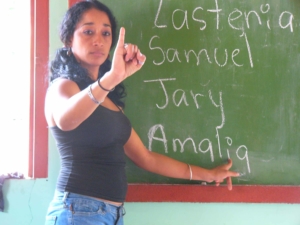
Daphne, a teacher at a school for the deaf in Bluefields, on the east coast of Nicaragua, helped teach some of the sign language workshops.
Meanwhile, the Sister Islands Association has continued to fund sign language workshops on Ometepe. We have also partnered with the Nicaraguan Sign Language Project, a Maine organization founded by James and Judy Kegl. She is a professor of linguistics at the University of Southern Maine who first went to Nicaragua in 1986 at the request of the Nicaraguan Ministry of Education to help develop programs based on Nicaraguan Sign Language, or ISN (Idioma de Señas Nicaragüense).
To see a photo exhibit taken by 15 deaf students on Ometepe, click here. You can also view a video about the project by clicking here.
To learn more about the fascinating history of the development of Nicaraguan Sign Language, click here or see this.
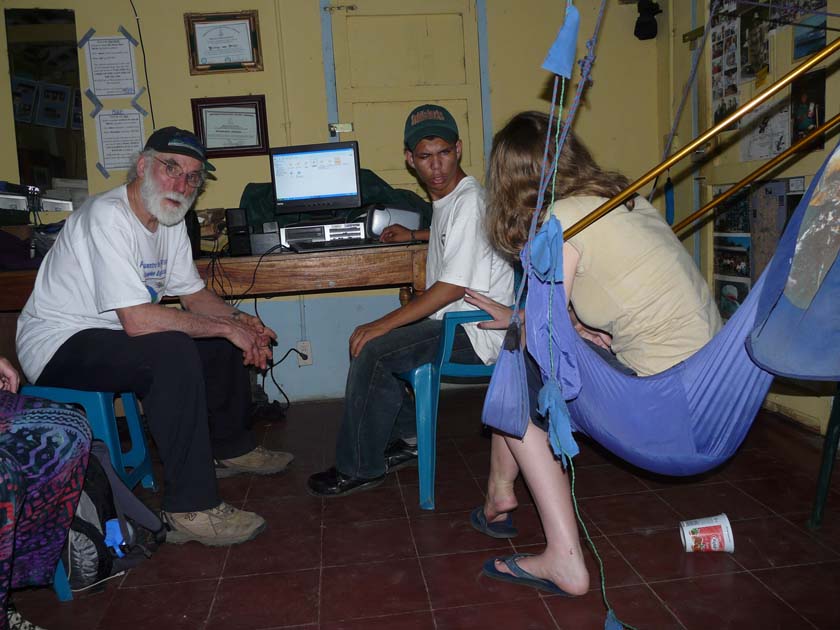
Yadder Guillen shows members of the Special Needs Delegation how he and other blind students use a computer equipped with a program that reads aloud the text on the screen. The students visit the Sister Islands office regularly to use the computer.
Programs for blind students
Since Sister Islands installed two text-reading computers in our office in Altagracia, blind students come to the office nearly every day to use these computers to explore the Internet, communicate via e-mail, and write and print school assignments. Blind students in Altagracia have become a tight-knit group and have communicated with blind students in other communities in Nicaragua, which has led to some enriching experiences. For example, the Sister Islands Association responded when Jader Guillen, one of the leaders, asked for funding to bring a Managua team to Ometepe for a goalball tournament. Goalball, invented in 1946 as a way of rehabilitating blind war veterans, uses a ball that makes noise when it is in motion. Players wear blindfolds, eliminating any advantage for those who have some ability to see.
Programs for people with other special needs
As a result of the conference in 2009, a local chapter of the national Nicaraguan organization for people with special needs, Los Pipitos, was formed on Ometepe. Los Pipitos sent a brigade of 18 doctors and nurses to the island to assess the situation and provide initial services. The leadership of this local group has established a clinic in Altagracia. With financial assistance from Sister Islands, they provide services for people and families with a variety of special needs, such as Down Syndrome, Spina Bifida, Cerebral Palsy, growth problems and learning disabilities. The local chapter continues to receive different types of support from the national Los Pipitos. Currently a family on Bainbridge Island provides a scholarship for one of the volunteers at the clinic to study nursing, with an emphasis on serving people with special needs.
Special Olympics for special Ometepinos

Norlan and Francisco compete in the sack race during “Los Olympipitos” in 2014.
Imagine hopping in a sack race with your eyes covered, listening for clapping to indicate where you turn around and go back to the start. For the two blind students who participated in the 2014 student delegation’s “Olympipitos,” this event was a chance to display fearlessness and independence that amazed the audience. “Los Olympipitos” (combining “Olympics” and “Los Pipitos”) drew in ten deaf students, four blind students, and ten students with other disabilities, accompanied by family members and friends. Each of a variety of games was sponsored by a different community on Ometepe where children with special needs live. Two dozen students from Bainbridge Island and an equal number of Ometepe high school students assisted with the first of what promises to become an annual event. Chaperone Colleen Carroll reflected the feelings of all who attended: “For me, the greatest thing of the whole day was watching our students and the Ometepe kids interact in such a genuine way, across the language barrier and across the ‘disability’ barrier that I think can be even more intimidating at times. Everyone was having a great time and just being themselves–even the older participants, some of whom are far older than our high school students, were caught up in the simple joy of playing games.”
How to get involved
Dale Spoor heads the Special Needs Committee. If you would like to become involved, please email using this form.
Read about the 2015 Special Needs Delegation to Ometepe.